Please Contact

For any Query Please Contact me : +91-9268291415- ,9555600055, : snnetworkdelhi@gmail.com


Showing posts with label SEO tips. Show all posts

Friday, February 6, 2015

8 Ways To Sell More Online With Behavioral Psychology

One of the most effective ways to sell online is to take advantage of behavioral psychology. In other words, being aware of what subconsciously triggers specific actions can significantly boost the performance of any marketing campaign. While the general idea of behavioral psychology applies to both online and offline marketing, the implementation differs dramatically.
Here are eight ways to leverage psychology to sell more online, with concrete examples you can implement instantly.

Three Ways To Get That Button Clicked

Optimizing the call to action has a huge impact on the conversion rate. An effective behavioral psychology strategy to increase clicks on the call to action is to use visual elements that make it stand out. This can be mainly done using three techniques:

1. Use Vivid Colors 

Using a yellow or a red button will stand out more than any other darker color. When people land on your website they will be naturally drawn to look at the bright color and understand in three seconds or less what they are supposed to do.
SEJ 1 behavioral psychology marketing
Source: Created by the author for the use of the Search Engine Journal
In the example above the red button has several advantages compared to the black one:
  • Red creates a more aggressive color contrast to the background of the page and therefore stands out more
  • Red increases the heart rate and therefore it is more likely to trigger the need to take action
  • Red is the ‘on sale’ color and therefore it is associated with getting a good deal
Black is typically associated with luxury and high prices (think of Dior or Armani for instance) and while it communicates power and suppleness, neither of those things increase the amount of clicks. If your goal is to generate as many clicks as possible a vivid color for the call to action button it the right choice. Testing different color shades is of course a must.

2. Use Visual Aids

Instead of simply letting the call to action button sit there, point it out. According to behavioral psychologists, it is more intuitive to click on a button if one is clearly supposed to. By placing something close to the button, the button itself is subconsciously perceived as less isolated, meaning it is not such a stretch to actually go ahead and click it.
Examples of good visual aids are:
SEJ 2 behavioral psychology marketing
Source: Created by the author for the use of the Search Engine Journal

3. People Need to Look at the Call to Action

Whenever there are photos of people on the landing page, viewers are instantly drawn to the point the people in the photo are looking at. Therefore, the best photos are the ones that look at the call to action button.
A common problem with that is that viewers skip other content and look directly at the photos. In order to avoid that, place photos on the side where people start reading. If potential clients read from left to right, the photo should be on the left. If they read from right to left, the photos should be on the right. 

Make It Feel Like A Deal

Behavioral psychology has proven the way the price is presented dramatically changes the conversion rate of landing pages. A good pricing technique is offering alternative solutions to your pricing that are not actually meant to sell but are only there to make whatever you want to sell look like a deal.
For instance, let’s imagine you sell a subscription service and have the following pricing:
SEJ 3 behavioral psychology marketing
Source: Created by the author for the use of the Search Engine Journal
Looking at the pricing above, people are getting two prices but they do not really know if your price is convenient or not. You are missing something that helps people understand that “video trainings + strategy newsletter” is worth paying $19.99 for. Look at how this third offer (which is likely to have no market share whatsoever) changes the perceived value of “video trainings + strategy newsletter”
SEJ 4 behavioral psychology marketing
Source: Created by the author for the use of the Search Engine Journal
Nobody is likely to purchase the third offer but “video trainings + strategy newsletter” is now perceived as much more valuable than in the previous scenario.

Upsell Before The Checkout

You should take advantage of the fact that people decided to purchase from your website. You managed to break down the barrier between your product/service and the customer. Psychologically, people tend to say yes to something new when they already agreed to something else before. Therefore it will be easier to upsell to the same customer than finding new ones.
Note: it is the timing of the upsell that seals the deal because the momentum has passed after the checkout and upselling is therefore easiest just before the end of the checkout process. 
Effective up-selling strategies are:
  • “Customers who ordered this item also bought:”
  • “Add product xyz and get free shipping”
  • “Add product xyz to get a one time discount of X%”
GoDaddy is the perfect example regarding upselling. For instance, when you look up the availability of a domain you will get an immediate upsell for domains with a different ending to secure the name you just found.

1. First Two Upsells: Above the Fold

This amounts to a total upsell value of €13.55.
SEJ 5 behavioral psychology marketing
Source: Screenshot of Godaddy.com

2. 94 Upsells: Below The Fold

They also include premium accounts for a total value exceeding €10,000. Go Daddy does a great job at pressuring customers in protecting their own name and buying extra domains to feel safer.
SEJ 6 behavioral psychology marketing

3. Move to Page Two and Get an Upsell Above the Fold

SEJ 7 behavioral psychology marketing
Source: Screenshot of Godaddy.com
This page is extremely clever, because you can continue immediately to the cart but they actually write “scroll down to continue to the cart”, which lets you go through three other upsells: Website builder + hosting or hosting and the purchase of a professional email address. In total, we have a total upsell of roughly €15 per month. 

4. Include Two More Upsells on the Final Checkout Page

SEJ 8 behavioral psychology marketing
Source: Screenshot of Godaddy.com

Create a Sense Of Urgency

The more time sensitive your promotion is, the more likely people take action. Creating a sense of urgency quickens the decision-making process even if they are not sure whether the promotion will really expire.
There are several ways to create a sense of urgency: 
  • Limited availability
  • Having a countdown on the website saying when the promotion is going to end
  • Upcoming price increase
  • Helping readers understand the importance of receiving a piece of information sooner rather than later
There are of course countless ways to create a sense of urgency and they should be split tested to find the one that is most profitable. This concept applies to marketing material across the board and can be split tested with an online versus offline comparison in mind. 

Take Advantage Of The Power Of The Word ‘FREE’

You might have heard about the behavioral psychology experiment run by Duke University’s Dan Ariely. Two types of chocolate were put on display at the counter: Hershey kisses for 1 cent and Lindt chocolate truffles for 15 cents. Customers were informed that both chocolates were on discount resulting in the just mentioned prices and that they could have either one or the other. 70% bought Lindt even when the price was increased by 1 cent for each of the chocolates. 
However, when the Hershey kisses were offered for free and the Lindt truffles at 14 cents, meaning both were lowered by 1 cent from the initial price, 69% of customers chose the free Hershey kisses.
This test has proven that FREE is sexy and that anytime something is free, people will most likely give it a shot instead of paying for something that is actually the better deal.
If the goal is that people use/read/test something, give it away for free and offer something paid at the same time to increase the feeling of getting away with a freebie.

Give User The Option To Learn More About An Upsell

If you are not a fan of aggressive up-selling, simply offer the option to learn more about an additional product or service during the checkout process.
For instance, you could have a checkbox at the bottom of your checkout button saying “Yes, I want to learn more about how to save 30% on my next purchase”. If people check the box, the offer page opens and they are more receptive to it because of the psychological effect discussed earlier: if someone agrees to someone once, it is more likely that he/she says yes again right after. 
An example of a checkout page using this technique would look like the following:
SEJ 9 behavioral psychology marketing
Source: Created by the author for the use of the Search Engine Journal

Watch The Way You Speak!

Write content as if readers have already decided to go through with the purchase. For instance, replace phrases mentioning “if you buy” with “when you will be using”, “the advantage of our product” with “You will love our product right from the first time you use it” . All scenarios should use phrases that imply the readers are already sure about buying the product.
This concept also applies to live demos and videos. You need to make users feel as if they already own the product and conversion rates will increase. 

Leverage On The Sense Of Belonging

Researchers at the University of California proved that social pressure and a sense of belonging can determine behavior. They randomly assigned one of two cards to several guest rooms. One card had a standard environmentally friendly message and the other stated that x% of hotel guests reused their towels.
On average, people staying in the rooms with the cards with the percentage reused their towels 25% more than people with the environmentally friendly card. 
Based on the results of this study, there are countless options to boost conversion rates. For instance, showcase your most popular package saying how many people prefer it to another solution. People will immediately identify with that and be more likely to complete a purchase. Another example could be upselling an item saying “80% of customers who bought this product also purchased…”. 

Conclusion

In order to master behavioral psychology and significantly boost online sales, it is not enough to implement strategies once and never optimize them again. A common mistake is to make a button red and let it sit there. Seemingly insignificant details like the shade of red for the call to action button can make a difference and should be split tested to maximize the effects of behavioral psychology.

Souces : http://www.searchenginejournal.com/8-ways-sell-online-behavioral-psychology/123921/

Tumblr Marketing: 10 Examples of Effective Brands Doing It Right

If you still haven’t jumped on the Tumblr bandwagon, now is the time to get moving on that. After all, according to QuickSprout, Tumblr’s traffic is growing at a rate of 74% a year. And, along with over 300 million unique visitors per month, Tumblr has become a goldmine for anyone wanting to spread brand awareness.
Tumblr states it “is ranked #1 in social sentiment towards brands”. Furthermore, if you were to use Tumblr’s sponsored posts, you could reach more than 800 million visitors – thanks to Tumblr being a part of Yahoo. Of course, you can’t just dive into the world of Tumblr without doing a bit of homework. That’s why you should do some preparation before entering this world of teens and millennials. Here are a handful of tips to keep in mind when tinkering around with Tumblr marketing.

Create a Strategic Plan for Tumblr

In KISSMetrics’ “The Marketer’s Guide to Tumblr,” it’s suggested that if you’re not familiar with using Tumblr for marketing, you sit down with your team and ask the following questions:
  • Why do you want to create a Tumblr blog?
  • Who will run the Tumblr blog?
  • Who is your audience?
  • What will be the focus behind your Tumblr blog?
  • What are your weaknesses and strengths?
  • Are you truly committed to this effort?

Know the Culture and Language of Tumblr

Remember, Tumblr is full of niche communities and subcultures that use their own dialects (for example: hyperbolic language, irony, or loose grammar) and resources such as reaction GIFs or clever Tumblr domain names. This may be intimidating at first, but it also means you can experiment until you find your voice on Tumblr.
Kevin Shively, senior marketing manager at Simply Measured, suggests to Amanda Walgrove on Contently, “Understanding the network and audience you’re marketing to is crucial no matter where you are, but even more so on Tumblr, which has managed to maintain an ‘underground appeal’ to a lot of niche markets.”

Follow Your Fans and Share Their Content on Tumblr

Tessa Wright states on Content Marketing Institute that, “following your consumers is an important courtesy that shows your brand is listening and appreciates what they have to say.” Wright uses the HBO series Games of Thrones as an example. The Tumblr blog “maintains an open call for creations on its Tumblr page, and the quality of the submissions it receives is simply stunning”. HBO can then use entries to promote on its other social media outlets. HBO also uses Tumblr to increase engagement by running contests.

Let Tumblr Help

For the last couple of years, Tumblr has done a rather solid job of assisting brands in getting started. In fact, once you land on the Tumblr Business page you’ll spot a clickable button that will let you contact a brand strategist. In addition to that, there’s also Tumblr’s Creative Cooperative. This is “a series of workshops for brands and agencies that teach creatives how to speak Tumblr, build a fandom and create content.” So, if all else fails, reach out to Tumblr to help your brand get the ball rolling.
Now that you have some stats and tips on why Tumblr is a great platform for marketing your brand, let’s take a look at 10 examples who are doing it right – in no particular order.

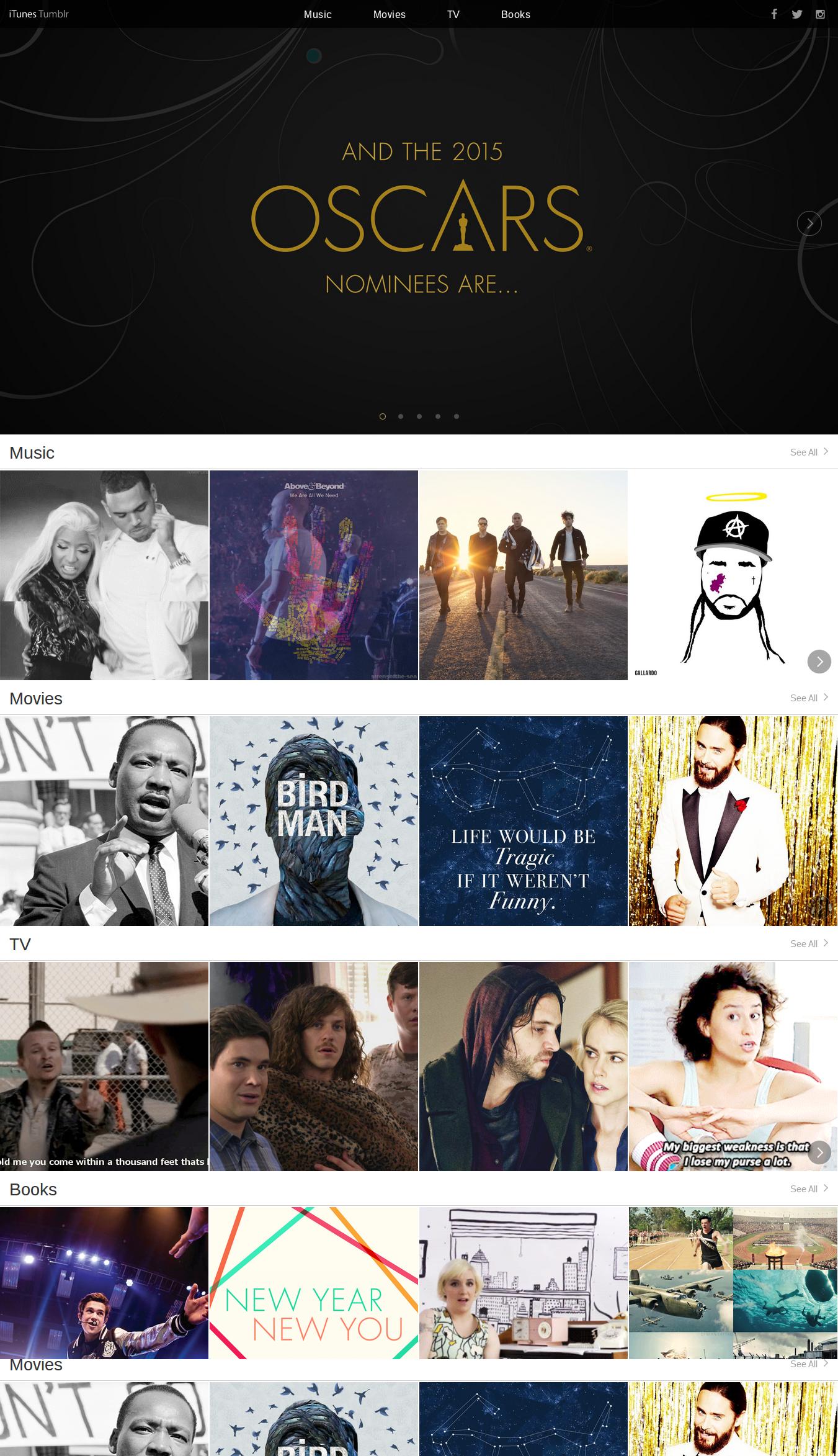
1. Apple

iTunes Tumblr - 2015 Oscars Nominees
Tumblr iTunes screenshot taken January 22, 2015
Apple is pretty notorious when it comes to using social media for marketing campaigns. However, when the brand released a campaign for the iPhone 5C in March 2014, Tumblr was the brand’s first choice. The webpage called “ISee5c” featured videos of the various phone colors with a different song for each. According to 9to5Mac, some on Tumblr reported “that the iPhone 5c colors Tumblr page is showing up as a Sponsored Post in their Dashboards. This means that the page’s creator is paying Tumblr/Yahoo for the iPhone 5c page to show up as an advertisement.”
Recently, Apple returned to Tumblr with a new iTunes site, which pretty much mirrors the design of the iTunes store. As TechCrunch reports, the site is “currently promoting the ‘best of 2014’ in music, movies, TV and books. The blog features ‘best of’ videos for each category, combined with shareable GIFs, images, quotes, and other content ideal for reblogging.”
Why This Is Effective: As mentioned on Digiday, “a look at how Tumblr’s user demographic (56.1 percent are 34 years old or younger) coincides with the iPhone 5c’s customer (56.6 percent are 34 or younger).” In other words,  this was a perfect match. In the future, Apple can continue to use Tumblr as way to reach younger audiences – like it could currently be doing with the iTunes Tumblr.

2. Lexus

THE SIGNAL
The Signal screenshot taken January 22, 2015
You wouldn’t think that a luxury like Lexus would embrace a platform like Tumblr. But, not only did Lexus do just that, the brand also unleashed an award-winning Tumblr campaign. With the edgy “The Signal” campaign, Lexus focused on creating ads that more closely resembled fashion ads, as opposed to just another automobile Tumblr account. This was done by curating authentic content that tapped into the most popular Tumblr tag categories. The result? “The Signal” was awarded the Best Tumblr Campaign at the 6th Annual Shorty Awards in 2014.
Why This Is Effective: When Lexus released the IS, it wanted to reach people mainly under the age of 46. The problem? The brand realized that it “was increasingly losing relevance” to this target audience. It also took “declining appeal and lackluster sales” for Lexus to realize that its brand no longer stood out. To appeal to their target audience, Lexus designed a vehicle that Gen X and Y would want to drive; and they used Tumblr to deliver that message. As a result, “The Signal” successfull was able to reach that demographic, “with visitors to the blog indexing highest in the 25 – 34 age range, followed by 18 – 24.”

3. Vans

Vans (1)
Vans screenshot taken January 22, 2015
As Christopher Ratcliff states on Econsultancy, “Vans does an excellent job in tapping into its own cultural heritage and providing a social experience that is in turns aspirational, inspirational, and nostalgic.” Furthermore, the brand uses social media as “a mutually beneficial exchange, the brand defines the community and the community defines the brand.” So, it should come as no surprise that Vans also has an awesome Tumblr. For starters, Vans has high-quality and creative images that represent the lifestyle of its audience – from both the brand and fans. It also does an excellent job of tying in its other channels so that you can share and interact with the brand across multiple platforms.
Why This Is Effective: Vans knows where its audience hangs out. The challenge, then, is creating content for the platform that their audience will engage with and share. The Vans Tumblr definitely achieves that by embracing the rebellious, communal, and youthful spirit that the brand has become known for.

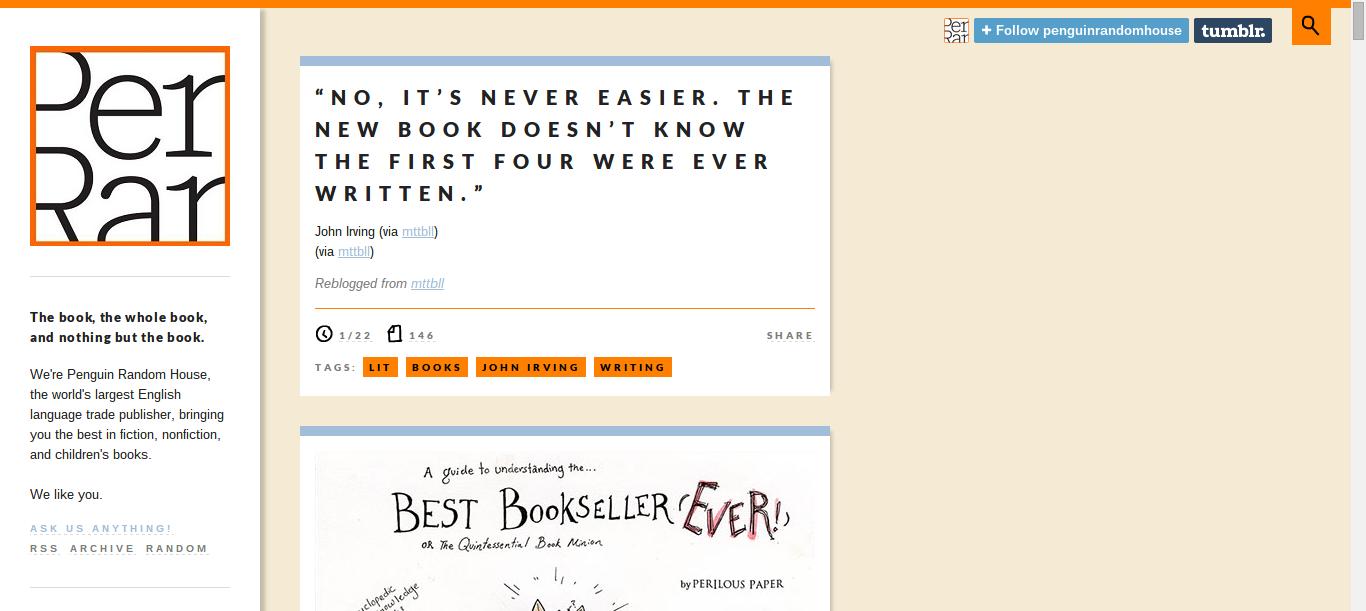
4. Penguin Random House

Penguin Random House
Screen Shot Penguin Random House 1/22/15
When author Rainbow Rowell created Tumblr’s Reblog Book Club, she was interviewed by the LA Times. What was interesting was the Rowell stated that she had seen “LOTS of librarians” on Tumblr. She even described it as “a place full of enthusiastic readers and writers: poetry, fan fiction, novels, everything.” With that in mind, why wouldn’t publisher Penguin Random House have an active Tumblr? Every day, their Tumblr is updated with literary-related images, quotes, GIFs, videos, or links to purchase a book that has been mentioned.
Why This Is Effective: Knowing that there is a large community of literary lovers who use Tumblr as their social media preference, Penguin Random House manages to create a location for their audience to gather, share and view industry-related content.

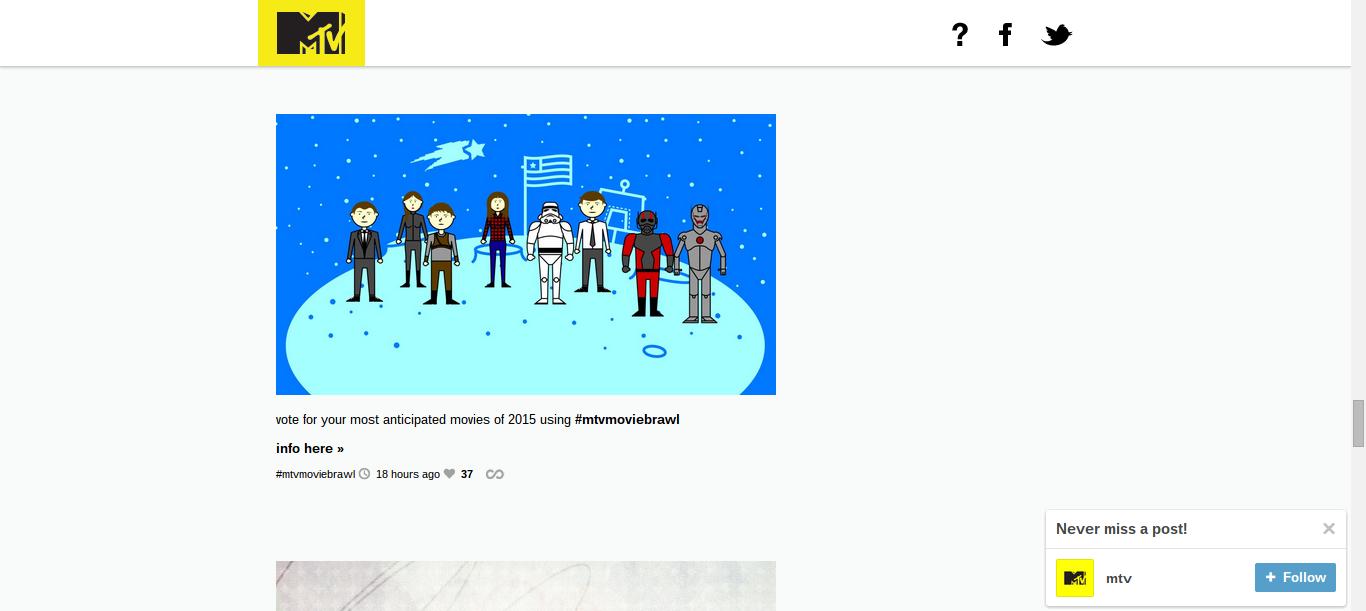
5. MTV

mtv
MTV screenshot taken January 22, 2015
This just makes sense. As a brand that appeals to a younger generation, MTV is very active on Tumblr. Most of the content involves images, GIFs, and Twitter snapshots of celebrities. However, MTV also shares social causes that its demographics may be passionate about. Of course, it also uses this platform to remind audience members when their favorite show is going to air.
Why This Is Effective: MTV knows where its demographic hangs out and knows the content that they are interested in. By posting several times a day, MTV is able to keep the attention of its young audience. Apparently, this relationship was good enough to strike up a partnership last year that involved Tumblr and Viacom teaming up “to ‘deliver co-branded campaigns for advertisers’ in 2014 for major properties such as MTV, VH1, CMT, Nickelodeon, and Comedy Central.”

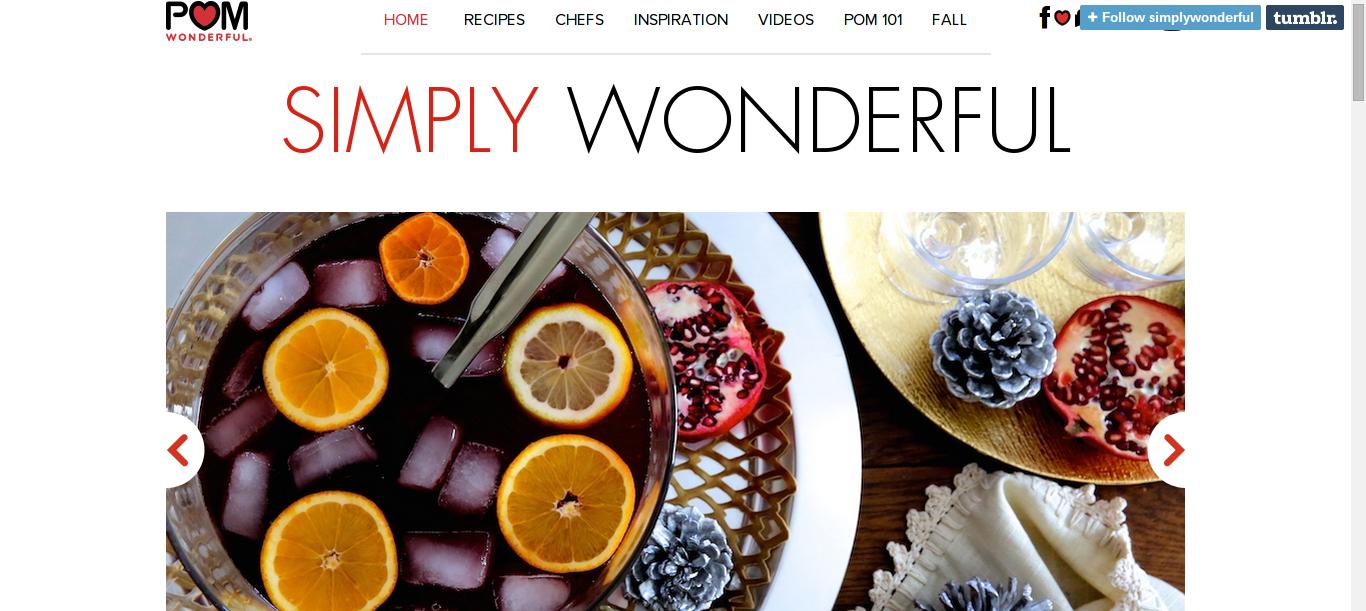
6. Pom Wonderful

Simply Wonderful
Simply Wonderful screenshot taken January 22, 2015
How could you possibly make a Tumblr blog involving pomegranate juice interesting? How about by converting the pomegranate into a full-fledged lifestyle? On Tumblr, Pom Wonderful shares rich content involving recipes, interviews with chefs, pomegranate basics, videos and even inspirational images of the fruit.
Why This Is Effective: This blog is a perfect example of what Tumblr is all about; curating content from all the over web that revolves around one specific item or interest. In other words, Pom Wonderful embraced the fruit that made it a successful brand and made it the star by only sharing content that involves pomegranates.

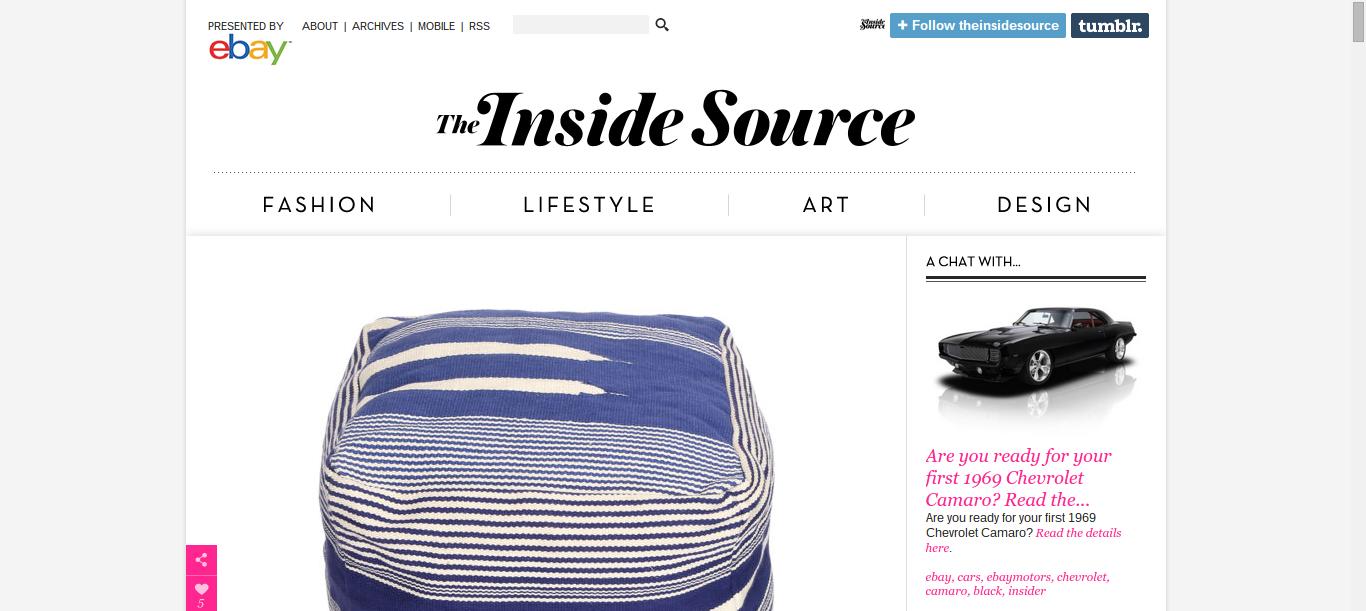
7. eBay

The Inside Source
The Inside Source screenshot taken January 22, 2015
Some of us would not consider eBay a fashion hub, or even a destination for trendsetters. But, it’s Tumblr, and The Inside Source proves otherwise. Janelle Vreeland states on Lonelybrand that ebay “has revamped its image to include discount offers from notable fashion brands, a partnership with Rue La La, a new fashion-focused app, and a new Pinterest-inspired appearance.” Through Inside Source, eBay can share the latest tips and trends in fashion, art, design and lifestyle. Does this mean that eBay has neglected its brand? Nope. As Vreeland says, “The Inside Source still keeps the eBay brand and the service it provides front and center,” by linking to similar products that are available for purchase on the site.
Why This Is Effective: There are a couple of things eBay is doing right with Tumblr. For starters, it focuses on a niche. It created a Tumblr that focuses on high-quality images showcasing trendy fashion and design items. Once the audience has been hooked, it links to eBay for purchase. Another thing that eBay has succeeded in doing is highlighting top sellers by showing off their product listings on Tumblr.

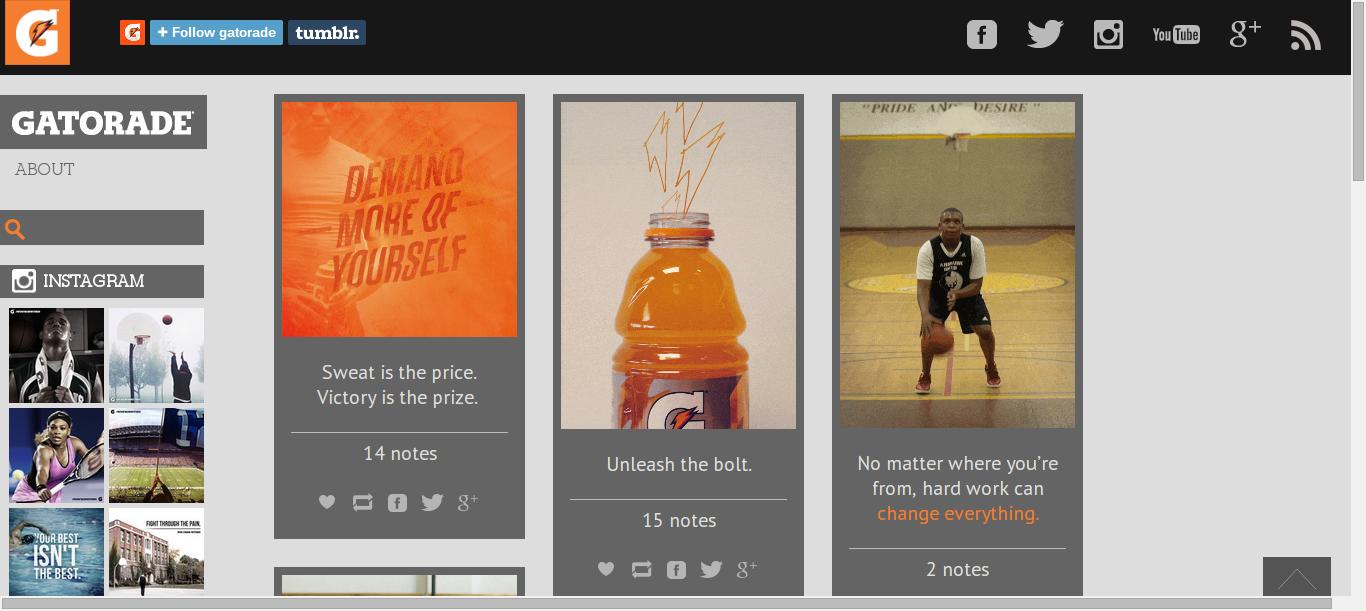
8. Gatorade

Gatorade - Tumblr
Gatorade screenshot taken January 22, 2015
Gatorade’s Tumblr is sports focused – which just makes sense when you manufacture sports-themed beverages and food products. Included on the Tumblr are motivational quotes, vintage images, athletes, videos, and GIFS. What’s really clever about this site is that Gatorade embraces other channels – there’s a collection of Instagram images on the left side of the screen in plan view. Another example is featuring GIFs taken from inspirational videos created by the brand, like this one featuring 12 year-old Erica Wilson.
Why This Is Effective: Gatorade is strictly focusing on sports enthusiasts on Tumblr. That may seem bit too broad, but there’s enough content here to reach fans of any sport – and Gatorade can use timely sports content throughout the year, such as baseball in the spring or summer. What I really like about this Tumblr is how easy it is to share the content – just click on an image and share with the network you want. And, as I already mentioned, it seamlessly integrates with other platforms.

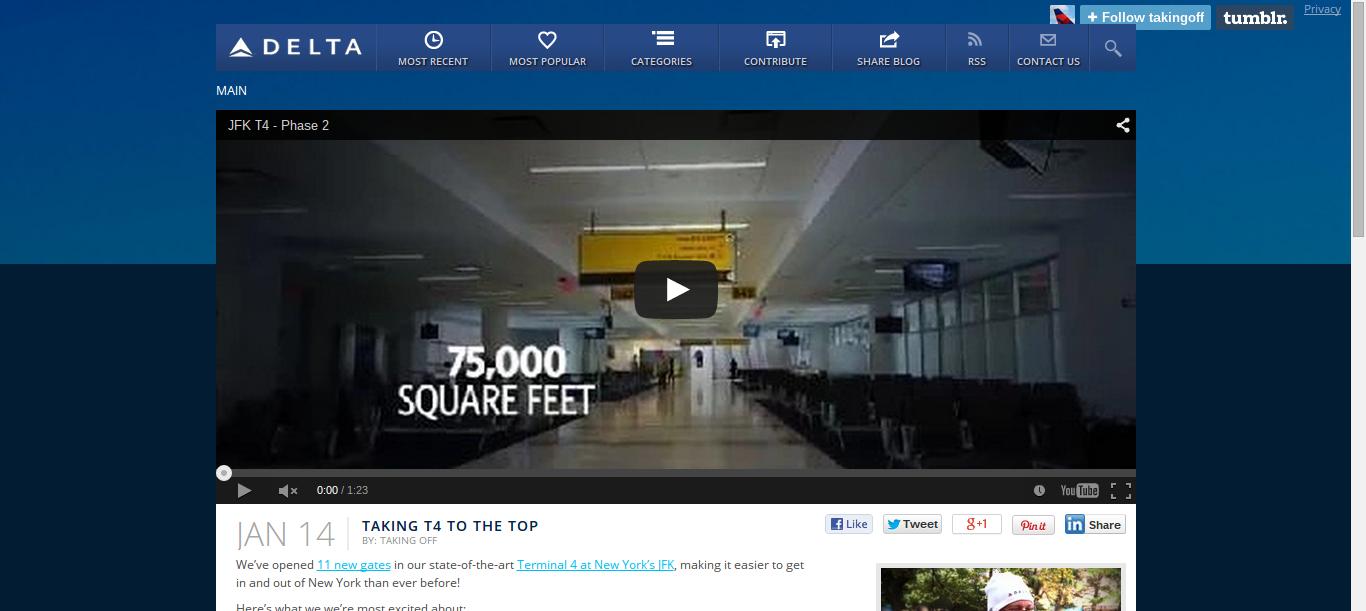
9. Delta Airlines

TAKING OFF — Taking T4 to the Top By- Taking Off  We’ve ..
Taking Off screenshit
It’s not uncommon for brands to offer customer service via Facebook or Twitter. But, how about Tumblr? That’s what Delta Airlines has done with its Taking Off site. At the top of the site you’ll notice that there’s a Contact icon that can be used for any questions, concerns, or inquiries. However, Delta also has content that travelers can use to make their time at airport go smoothly. For example, they have an entry regarding its new terminal at JFK. Here visitors can view a video and read all about the new terminal so they’ll know what to expect, and maybe even get excited, when they arrive.
Why This Is Effective: If you’re involved in the hospitality industry, then you know that your customer service has to be superior. In fact, “customer service and marketing go hand in hand.”
By making it easier for customers to interact and find information they will find helpful and entertaining, Delta is able to market itself as a brand that cares about its customers.

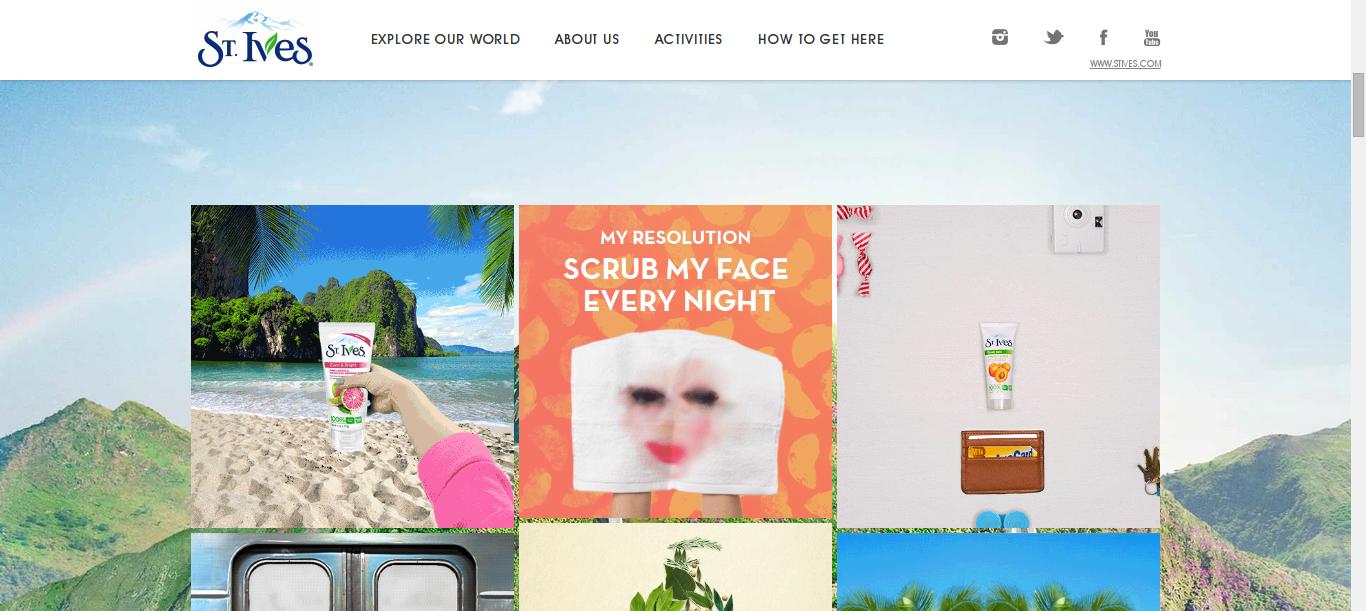
10. St. Ives

St  Ives
St. Ives screenshot taken January 22, 2015
With fun, exotic, and stunning imagery, the skincare company takes you from your boring real-life to an exciting fictional world that kind of resemble Hawaii. For example, there are images of people getting stressed, like during the holidays, that show them escape by thinking about St. Ives products. There are also animations, like a computer screen disappearing to reveal a beach. The company even ran a contest on Tumble for fans to actually win a trip to Hawaii.
Why This Is Effective: The St. Ives Tumblr has a theme – to make life more exciting and less stressful. While not all of us may relate skin care products to excitement or relaxation, it’s easy to understand why – it provides at least a temporary escape. And, the contest for the Hawaii trip was the icing on the cake to tie this whole theme together.

Conclusion

Tumble can be overwhelming, or even misunderstood, for brands. However, it has proven to be an effective and active community of people who are willing to share, create, and interact with each other. As long as you are aware of these communities, speak their language, create engaging visual content, and interact with your audience, you can use Tumblr as an effective marketing tool.
Is there a brand that you believe does exceptionally well on Tumblr with marketing?

Subdomains vs. Subfolders, Rel Canonical vs. 301, and How to Structure Links for SEO - Whiteboard Friday

There are some basic questions about SEO that come up really frequently, and it's often easy to assume an answer that isn't exactly right. In today's Whiteboard Friday, Rand tackles three of them:
  1. Should I put subsections of my site on subdomains or in subfolders?
  2. Should I use a rel canonical or a 301 redirect to move content on a separate site over to my main domain?
  3. If I have multiple websites all linking back to my main site, does that help or hurt my SEO?
Subdomain vs Subfolders
For reference, here's a still of this week's whiteboard


Video transcription

Howdy, Moz fans, and welcome to another edition of Whiteboard Friday. This week we're going to chat about structuring content, placing content, and placing links, specifically with regards to some things that have come up over and over again in the SEO world, but still seem to be a challenge for many of us who play in the field.
One of the questions that I'm going to start with is around subdomains and subfolders, because this just comes up again and again and again. I think one of the reasons it's emerged in the last few years is, unfortunately, some statements by Googlers themselves -- a statement a few years ago from Matt Cutts, and one, I think last year or two years ago, from John Mueller basically saying, "Hey, Google has gotten much better at identifying and associating content that's on a subdomain with the main domain, and you don't need to worry about placing content on two separate subdomains anymore."
I am sure that Google has actually made strides in this area, but this question still has the same answer that it did years ago. I'll show you some examples.
You're asking, "Should I put my content on a subdomain, or should I put it in a subfolder?" Subdomains can be kind of interesting sometimes because there's a lot less technical hurdles a lot of the time. You don't need to get your engineering staff or development staff involved in putting those on there. From a technical operations perspective, some things might be easier, but from an SEO perspective this can be very dangerous. I'll show you what I mean.
So let's say you've got blog.yoursite.com or you've got www.yoursite.com/blog. Now engines may indeed consider content that's on this separate subdomain to be the same as the content that's on here, and so all of the links, all of the user and usage data signals, all of the ranking signals as an entirety that point here may benefit this site as well as benefiting this subdomain. The keyword there is "may."
I can't tell you how many times we've seen and we've actually tested ourselves by first putting content on a subdomain and then moving it back over to the main domain with Moz. We've done that three times over that past two years. Each time we've seen a considerable boost in rankings and in search traffic, both long tail and head of the demand curve to these, and we're not alone. Many others have seen it, particularly in the startup world, where it's very popular to put blog.yourwebsite.com, and then eventually people move it over to a subfolder, and they see ranking benefits.
But even more telling was a recent example from just a few months ago on the iwantmyname blog. Timo Reitnauer wrote on the iwantmyname blog a piece about how he had moved their content actually from the main domain to a subdomain, which is not usually the way we see things going. But, man, when that happened, ugly, super, super ugly. You can see his traffic graph. He graphed his Google search traffic and showed, from his Google Analytics, a nice snapshot of when they made the move, what happened to their search traffic, how long it took to recover. It actually still hasn't recovered. It's been five or six months now. So very, very frustrating for them, and they're going to move it back over. I think maybe they already have moved it back over.
But this was great in that this piece went to the front of Hacker News. Lots of folks from around the startup and technology worlds commented on it, shared their experiences and opinions as well.
Bottom line is it's really dangerous to put content on a subdomain still. I believe John and I believe Matt when they say that Google has made strides in this direction. The problem is they're not good enough or perfect enough to rely on that factor, and so I'd really urge everyone to keep your content on one single sub and root domain, preferably in subfolders. That's how you're going to maximize your potential SEO benefit. This is one of those technical SEO things that just hasn't changed for many years now.
Next up, a question around rel=canonical, and 301s, especially cross-domain rel=canonical, meaning people are pretty comfortable with the rel=canonical that sits on your own website on your pages and maybe says, "Hey, the print version of this page should actually be considered the same as the web version of this page. Or the mobile version of this page should be considered the same as the regular version." That's fine.
But folks have more questions when it comes to cross-domain rel=canonicals and content that perhaps they own because they own multiple websites, or they have licensing agreements across those, or they have business development or partnerships, those kind of things. So they're wondering, "Hey, I've got content on multiple websites, and I want to move some of that content, or I want engines to interpret it all as coming from my site. Should I put it on the other website and use a 301 to redirect it, or should I use a cross-domain rel=canonical to say the old page is now the new page?"
Well, actually this is one where, from a technical perspective, the engines are doing a pretty darn solid job. Google is doing a very good job. We've seen Bing make strides here with cross-domain rel=canonical. They seem to be doing a pretty good job as well. I haven't tested them as intensely though recently.
Basic story is with the 301, other site.com/a can redirect to your site.com/a, and both visitors and engines, anyone requesting the old page, get the new page. The only difference with the rel=canonical is that when a visitor requests the old page, they're still going to get it. They're still going to get that othersite.com/b. Search engines, however, are going to get the new version of the page, or they're essentially going to consider these to be one and the same.
What we've seen is that, in both of these cases, the ranking signals seem to be passed very similarly, if not perfectly similarly, very similarly. It's hard to detect any difference there. But the rel=canonical can give you an option whereby you say, "Hey, I want to maintain the branding or some unique aspect of something that happens around othersite.com, and so I wish that I could have visitors be able to still go to that page, but have search engines know, hey this is actually just a copied version of this one, and if you're going to rank one of these two, I'd prefer you to rank this one."
That's a great use for the cross-domain rel=canonical. But this is much more a user experience and a branding experience issue than it is a technical SEO one, because both of these work pretty darn well.
Then the last issue I'll cover today are around some of this content and link optimization stuff is: What if you've got multiple websites all linking back to your main site, and you're wondering does that or would that help my SEO? I can't tell you how many folks, surprisingly even folks who are very savvy, who have done lots of other stuff in the technical and web development worlds, are thinking about this from a SEO perspective.
I can understand where it comes from. Basically, you have this understanding that more links is a good thing and that more link diversity is a good thing. So you think to yourself, "Hey, maybe I can capture more links and more link diversity by having more slightly different websites. I want to keep my main site all about one particular topic or one particular niche of that topic, and I want to have these other niche sites that maybe I have some great domain names in my portfolio or some really brandable ones. Maybe I've picked up some old domain names that I've bought, or I've bought entire properties outright. So what I'm going to do is I'm just going to add a site-wide link or many links from these pages all back over to my main site."
What you're hoping is that this will amplify your ranking signals and amplify your opportunity. The opposite is true. In fact, what's happening is you're creating a barrier for the full link equity for brand, user and usage data signals, and any potential social signals. You're creating a barrier that's stopping some of those things from passing fully here.
Let's just imagine that you've got four links over here, and they are all pointing to mysubsite1.com, which you're then thinking, "That's great. That's exactly what I wanted to have happen, and now mysubsite1 is pointing to my main site." You're actually losing most of the link equity, the value, the ranking power that would be passed if only two or three of these links had linked directly over to your main site.
As we talked about with the subdomain/subfolder issue, by collecting all of the ranking signals on one sub and root domain, you create the best possible benefit. This concept of domain authority -- I don't necessarily mean the number in Moz's Mozscape Index -- the concept of domain authority is that basically as a domain becomes more popular, as it inherits all of these ranking signals, could come from links, from visibility, from branding, user and usage data, all the kinds of signals that a domain inherits, it passes those on to all of its different pages. But it doesn't pass them on to other sites.
That's true for each of these as well. They're inheriting signals that they're not fully passing on here. I'd recommend that you 301 redirect all of these and have one main site. It simplifies a bunch of your work and streamlines it. It lets you focus on building this one brand. Branding is so powerful today and online visibility as a whole, not to mention SEO, that this is really a best practice.
I would get rid of those subsites as best you can. There are still reasons sometimes to have a microsite or a different website for branding purposes, or if you're going to sell that site separately, or if it's a completely different team working on it. But from an SEO perspective, everything on one sub and root is really ideal.
All right everyone, look forward to the comments, and we will see you again next week for another edition of Whiteboard Friday. Take care.

Souces : http://moz.com/blog/subdomains-vs-subfolders-rel-canonical-vs-301-how-to-structure-links-optimally-for-seo-whiteboard-friday